


Armenia and Georgia in a week
8 days / 7 nights
availability
From May 1 to September 27 inclusive.
days of arrival
Every Tuesdays and Thursdays
Detailed Descriptions
Arrival in Yerevan. Transfer to the selected hotel
Meeting at the airport. Transfer to the selected hotel.
Overnight in Yerevan
Yerevan - Khor Virap - Noravank - "Hin Areni" winery (tour and tasting) – Yerevan
Breakfast at the hotel.
A trip to the Ararat Valley to the Khor Virap Church. From here you can enjoy a unique panorama of the beautiful sparkling snow-white peaks of the biblical Mount Ararat. There is a sacred place deep under the church: Gregory the Illuminator spent 13 years in prison here in a dungeon by order of King Trdat for spreading Christianity in Armenia. After his release in 301, Gregory the Illuminator consecrated the Armenian people and Christianity was adopted in Armenia as the state religion. The Khor Virap Church was built on the place of Gregory the Illuminator’s imprisonment, which became a holy place for the entire Christian world, and Gregory the Illuminator was elevated to the face of saints and is considered the founder of the Armenian Apostolic Church. The entrance to the dungeon has been preserved in the church, so there is an opportunity to go down the stairs and inspect the place of imprisonment.
Not far from the church are the ruins of the ancient capital of Armenia Artashat, which is one of the few ancient cities built according to a special project. The author of the city plan was the commander of ancient Carthagen, Hannibal, who fled to Armenia after losing the war with Rome.
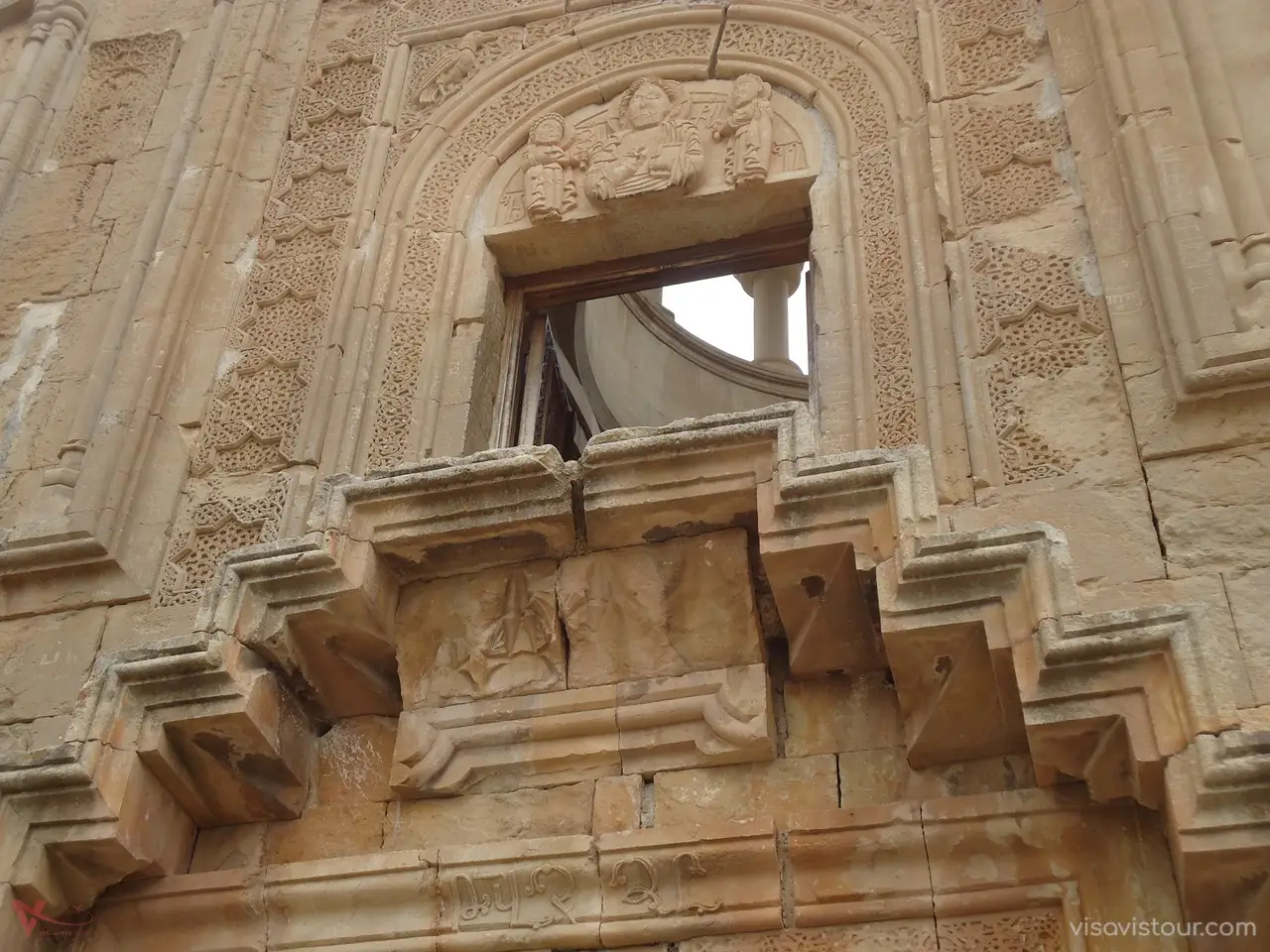
A trip to the Noravank monastery complex (XIII- XV centuries), which is an outstanding monument of medieval architecture and a major religious and cultural centre. Located among the bizarre steep red rocks on the ledge of a winding gorge, it is an extraordinary sight in its beauty. The western facade of the building is especially beautiful, decorated with cantilevered stairs leading to the second floor.
Passage through Areni is the cradle of winemaking. During recent archaeological excavations in the Areni area (Vayots Dzor province) in modern Armenia, a winery and 5 wine cellars from 6,100 years ago were found. Archaeologists have discovered containers for pressing grapes, fermenting and storing wine, drinking bowls, vines and seeds. This winery and cellar are currently recognized as the oldest in the world. Archaeologists suggest that our early ancestors used wine in ceremonies honoring the dead, as well as as a gift placed inside tombs. This is evidenced by the wine jugs and cups found in the burial places. According to Armenian and American scientists, these are the only complete and most ancient excavations in the world for the production of wine (more than 6000 years). These findings indicate a high level of winemaking in those days on the territory of Armenia. A visit to the Hin Areni winery, a tour of the factory and a tasting of wines of different varieties.
Return to Yerevan.
Overnight in Yerevan.
Waking city tour of Tbilisi – Excursion to Mtskheta
Breakfast at the hotel.
Drive to the ancient city of Mtskheta, the first capital of Georgia. The city is beautifully located at the confluence of the Kura and Aragvi rivers..
One of the main highlights of Mtskheta is the Svetitskhoveli Cathedral (11th century), which translates as “Life-Giving Pillar.” It was initially a wooden structure built in the 4th century, later replaced by a basilica in the 5th century, and finally the current cathedral was constructed in the 11th century. It remains one of Georgia’s main spiritual centers.
The next stop is at the Jvari Monastery (6th century), meaning “Holy Cross,” a masterpiece of medieval Georgian architecture celebrated in the poems of Mikhail Lermontov. Located on a mountaintop, it is a sacred place where Saint Nino, the Enlightener of Georgia, erected the first Christian cross.
Both Jvari Monastery and Svetitskhoveli Cathedral are listed as UNESCO World Heritage Sites.
Our next excursion is to get acquainted with Tbilisi (from Georgian ”Warm spring”), the capital
and largest city of Georgia, located in the valley of the Kura River (Mtkvari).
The history of the city can be studied by its architecture. A tour of the old city, a visit to the Narikala Fortress – one of the most famous ancient monuments of Tbilisi antiquity; locals call it the soul and heart of the city. This is the best observation deck in the city, from where a beautiful view of the entire Old Town opens up. To feel the pulse of Tbilisi, you need to walk along Shota Rustaveli Avenue, where the National Museum of Georgia, the Rustaveli Cinema, and the Church of St. George (Kashueti) are located. The color of Tbilisi consists of a sharp contrast of old quarters, houses with openwork wooden balconies, ancient dilapidated fortresses and modern business centers.
Overnight in Tbilisi
Tbilisi – Rabati Fortress - lunch - Vardzia (rock monastery and cave city) - Gyumri - Yerevan
Breakfast at the hotel.
The Rabati Fortress, or as it is also called the Akhaltsikhe Fortress, was built in the Middle Ages in the city of Akhaltsikhe in southern Georgia. This fortress was repeatedly in the epicenter of battles with Turkish troops and its appearance was significantly damaged.
In 2012, its global reconstruction was completed. The territory of the Rabati has significantly expanded and is divided into 2 parts: the upper (historical) and the lower (modern). The upper fortress houses: the Samtskhe-Javakheti Region Historical Museum, the Hadji Ahmed Pasha Mosque (Ahmediye), the Pasha’s Tomb, the 9th century Orthodox Church, the citadel and the amphitheater. On the territory of the lower part of the fortress there are tourist services. Nowadays, the Rabati fortress is one of the best attractions in Akhaltsikhe, visited by tourists.
Lunch.
Then we visit Vardzia (12th-13th centuries). This is a cave complex in the Kura River valley. It is a real city with streets, temples, fortresses, stairs, carved directly into the rocks. Vardzia is 800 m long, 50 m deep, and 8 stories high. The city had a protective and spiritual function. There is also a church carved into the rock, the Assumption of the Virgin Mary. Fragments of frescoes depicting Queen Tamara and George III have been preserved.
This is where the route through Georgia ends. Return to Armenia.
On the way, an introductory stop in Gyumri.
Gyumri (1500m) is the second largest city in Armenia, the administrative center of the Shirak region, located 126 km from Yerevan, surrounded by mountain ranges. Gyumri was originally called Kumayri, and its history is closely linked to numerous events and changes, from the Cimmerian invasions to the periods of Persian and Russian influence.
In 1837, Nicholas I renamed the city Alexandropol in honor of his wife Alexandra Feodorovna. Thanks to the construction of the Caucasian Railway in the early 20th century, Alexandropol became the third most important trade center in Transcaucasia. Later, the city was named Leninakan, and in 1991, with the independence of Armenia, it was again renamed Gyumri.
In 1988, the city suffered a devastating earthquake, but after restoration work, its historical center retained its charm and authentic appearance, attracting tourists with its ancient buildings, cozy streets and workshops of local artisans.
Today, Gyumri is a cozy, clean town with two-three-story tuff houses of various colors with cute carved wooden balconies. The city has many interesting historical and cultural places: the Black Fortress, the Minas Museum, the churches of St. Jacob, St. Gregory the Illuminator, the Marmashen Monastery, many small shops and cozy street cafes, where it is very pleasant to sit surrounded by the greenery of the park with a cup of coffee and enjoy the pleasant aura of the city. Gyumri is a city with a pronounced national flavor and this is reflected in everything: in the design of houses and hotels, cafes and restaurants, sculptural compositions on the streets. And this is perceived as warm and comfortable. It is pleasant and easy to walk along the cozy narrow streets of Gyumri. You can take many interesting photos as a memory of the city.
Return to Yerevan.
Overnight in Yerevan
Yerevan – Garni Temple (lavash baking) – Geghard Monastery – Yerevan
Breakfast at the hotel.
Excursion to the pagan Temple of the Sun (1st century AD) in the village of Garni.
Built in classical Greco-Roman style with a full colonnade and perched on a cliff overlooking a deep gorge, the temple offers a striking and surreal view. Garni once served as the summer residence of the royal Arsacid dynasty. The temple was destroyed by a powerful earthquake in 1679 and later restored between 1969 and 1974.Parts of the surrounding fortress wall have survived, along with ruins of the royal palace and ancient bathhouse. Of particular interest is the bathhouse’s mosaic floor, bearing the inscription: “We worked but received nothing.” Inscriptions in Greek confirm that the temple was built in 77 AD by King Trdat I of the Arsacid Dynasty.
Continue to Geghard Monastery, a rare and awe-inspiring 12th–13th century complex partially carved into the mountainside. The name “Geghard” means “Holy Lance”, referring to the spear that pierced Christ’s side during the crucifixion, which was long housed here (now in the museum of Etchmiadzin Cathedral). Nestled in a scenic gorge of the Azat River, Geghard is a masterpiece of Armenian medieval architecture. The complex includes a main church, two cave churches, and a royal mausoleum. In one of the cave chapels, a cold spring flows directly from the rock, believed to have healing properties, to restore youth and beauty. Geghard Monastery was inscribed as a UNESCO World Heritage Site in 2000.
Experience a demonstration of traditional Armenian lavash bread baking in a rural home. Watch this UNESCO-recognized practice as the dough is skillfully prepared and baked inside a clay oven known as a tonir.
Return to Yerevan.
Overnight in Yerevan
Yerevan sightseeing tour-walk
Breakfast at the hotel. Yerevan sightseeing tour, ancient (29 years older than Rome) and at the same time modern beautiful city with a unique flavor against the backdrop of the majestic biblical Mount Ararat, sparkling with its snow-capped peaks. The tour includes an introduction to the city center and its sights: the Opera and Ballet building, Republic Square, Swan Lake, Cascade, Northern Avenue and much more!
Overnight in Yerevan
Yerevan – Etchmiadzin (Saints Hripsime, Gayane, and the Mother Cathedral) – Zvartnots – Yerevan
Trip to Etchmiadzin (Vagharshapat) — the ancient capital of Armenia. Since the 4th century to this day, it has been the largest religious center and the permanent residence of the head of the Armenian Church — the Catholicos. The Mother Cathedral of Etchmiadzin (UNESCO) is the spiritual center of the Armenian Apostolic Church. It was founded in 301 AD by Gregory the Illuminator. Over the centuries, it was rebuilt and expanded, and today the complex includes the Mother Cathedral, the Theological Academy, the residence of the Catholicos of All Armenians, the Synod, and the church’s library. In the museum behind the altar are preserved artifacts of liturgical art: items made of gold, silver, and precious stones, religious ornaments, a massive silver cauldron for preparing holy chrism, and the legendary Holy Lance.
Visit to the Church of Saint Gayane (7th century AD, UNESCO) who, according to tradition, was martyred for spreading Christianity in Armenia. Located south of the Cathedral, it was founded in 630 AD by Catholicos Ezra. Later, a gallery was added to the western façade as a burial site for church hierarchs. The relics of Saint Gayane rest in the southern chapel.
Before entering the city of Etchmiadzin stands the majestic Church of Saint Hripsime (UNESCO), whose tomb is in a crypt beneath the altar. According to legend, she was tortured and killed for preaching Christianity in Armenia. At the site of her martyrdom, Catholicos Komitas built a church in the 7th century, as mentioned in an inscription on the western wall.
Continue to Zvartnots Temple (641–661 AD), one of Armenia’s architectural marvels, also known as the “Temple of the Vigilant Powers.” Its name comes from the Armenian word “zvart,” meaning “joyfully beautiful.” Originally a three-tiered structure supported by massive eagle-decorated columns, it was adorned with carved grapevines, pomegranate branches, and floral motifs. Though now in ruins, the remains still convey the rare beauty of this structure. Zvartnots is included in the UNESCO World Heritage list (2000).
Return to Yerevan.
Overnight in Yerevan.
Transfer to the airport and departure
Breakfast at the hotel. Check-out before 12:00. Transfer to the airport 2.5 hours before departure
Tour Package Prices Per Person in Double Room
| Hotel Name | DBL | SNGL | third adult | 6-12 Child |
|---|---|---|---|---|
| Elysium Gallery 3*, Mandarin or similar Elysium Gallery 3*, Mandarin or similar | ||||
| Ani Central Inn 4* or similar | ||||
| Ani Plaza 4*, Median or similar |
Tour Package Price Includes:
- Accommodation in hotels (7 nights, including 1 night in a 4* hotel in Tbilisi)
- Breakfasts
- Transfers and transportation services according to the program
- Services of a professional guide
- All entrance tickets, tastings and master classes according to the program
- Demonstration of the process of baking lavash in Garni
- 2 lunches in Georgia