


Introductory tour to Georgia and Armenia
8 days / 7 nights
Tour can be implemented in reverse order (arrival to Armenia and departure from Georgia) with arrivals to Yerevan on Thursdays and Fridays.
Period: whole year
Depending on arrival days there might be changes in sequence of tours.
availability
1 March till 15 November inclusive
days of arrival
Every week on Mondays and Tuesdays
Detailed Descriptions
Arrival to Tbilisi. Transfer to the hotel
Meeting at the airport. Transfer to chosen hotel. Overnight in Tbilisi
Walking city tour of Tbilisi – Excursion to Mtskheta
Breakfast at the hotel.
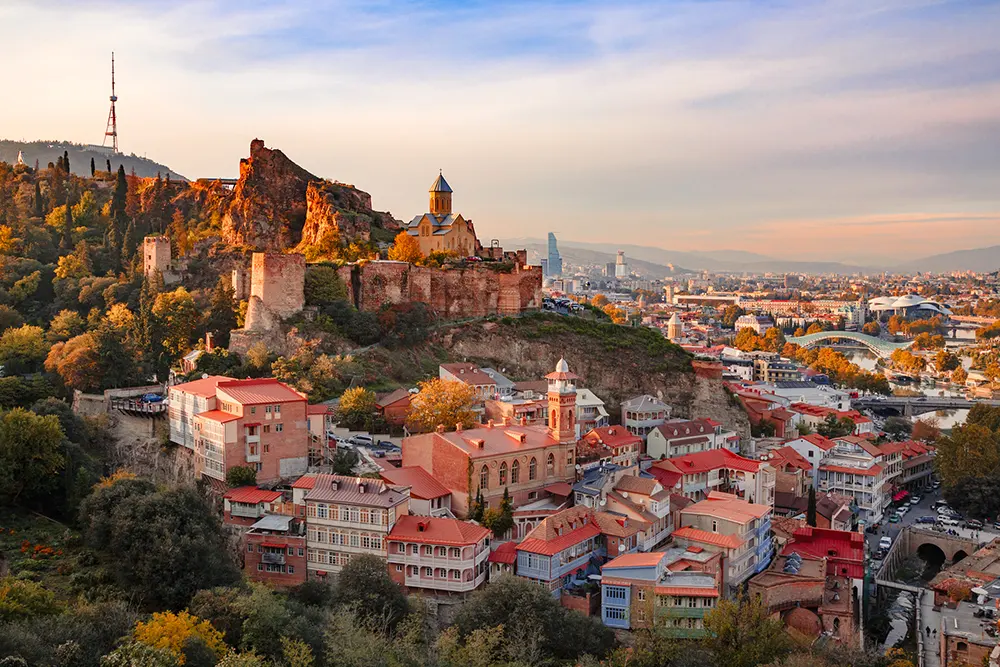
Begin your walking tour to explore Tbilisi (from Georgian “Warm Spring”), the capital and largest city of Georgia, located in the valley of the Kura (Mtkvari) River. The city’s history can be read through its architecture. Tbilisi’s charm lies in the striking contrast between old neighborhoods with carved wooden balconies, cozy courtyards, ancient semi-ruined fortresses, and modern business centers.
Visit the Old Town and Narikala Fortress—one of the most iconic ancient monuments in Tbilisi, considered the soul and heart of the city. This is the best viewpoint in town, offering a panoramic view of the entire Old City. Next, visit the Fig Gorge and the famous sulfur bath complex. Stroll through the alleys of the popular Sharden district. You will also enjoy a Georgian wine tasting in a traditional marani (wine cellar).
Continue to the ancient city of Mtskheta, the first capital of Georgia. The city is beautifully located at the confluence of the Kura and Aragvi rivers.
The first stop is at the Jvari Monastery (6th century), meaning “Holy Cross,” a masterpiece of medieval Georgian architecture celebrated in the poems of Mikhail Lermontov. Located on a mountaintop, it is a sacred place where Saint Nino, the Enlightener of Georgia, erected the first Christian cross.
One of the main highlights of Mtskheta is the Svetitskhoveli Cathedral (11th century), which translates as “Life-Giving Pillar.” It was initially a wooden structure built in the 4th century, later replaced by a basilica in the 5th century, and finally the current cathedral was constructed in the 11th century. It remains one of Georgia’s main spiritual centers.
Both Jvari Monastery and Svetitskhoveli Cathedral are listed as UNESCO World Heritage Sites.
Overnight in Tbilisi
Tbilisi – Kakheti – Sighnaghi ("City of Love") – Winery Visit – Wine Tasting
Breakfast at the hotel.
Travel to Kakheti, the heartland of Georgian winemaking. Its jewel is the Alazani Valley, home to famous wine-producing villages.
Visit the Kindzmarauli Wine Corporation, where you’ll learn about the traditional and modern techniques of Georgian wine production and enjoy a tasting of famous local wines.
(Optional) Enjoy a traditional lunch with a Kakhetian hostess in a local village. A beautifully laid Georgian table will welcome you with authentic dishes and hospitality. (Lunch not included in package price.)
Next, visit Sighnaghi, a charming small town in eastern Georgia also known as the “City of Love.” It is famous for its traditional Georgian-style houses with carved balconies and cobbled streets. Sighnaghi is also home to a well-preserved fortress, considered one of the largest in Georgia. The fortress walls still stand today, with 28 watchtowers offering spectacular views over the Alazani Valley.
Overnight in Tbilisi
Tbilisi – Haghpat Monastery (UNESCO) – Dilijan – Lake Sevan – Yerevan
Breakfast at the hotel.
Transfer to the Georgia–Armenia border, followed by border crossing.
Excursion to northern Armenia to visit the Haghpat Monastery (10th century) in Lori Province, a functioning monastery perched on a plateau surrounded by gorges. It was inscribed as a UNESCO World Heritage Site in 1996. Between the 10th and 13th centuries, Haghpat was one of Armenia’s leading religious and cultural centers, where humanities, theology, manuscript writing, and painting flourished. The great Armenian poet-troubadour Sayat-Nova lived here for a time, and his life was famously portrayed by director Sergei Parajanov in the film The Color of Pomegranates.
Continue to the mountain resort town of Dilijan, located at an altitude of 1,200–1,500 meters and surrounded by pristine pine forests.
Then proceed to Lake Sevan, one of Armenia’s natural wonders and among the world’s largest high-altitude freshwater lakes. Its brilliant blue waters and majestic setting make it a beloved subject for artists. Visit the Sevanavank Monastery, situated on the lake’s peninsula, offering breathtaking views.
Drive to Yerevan, Armenia’s capital. Check in to the hotel.
Overnight in Yerevan
Yerevan – Khor Virap Church – Noravank Monastery – "Hin Areni" Winery (Tour & Tasting) – Yerevan
Breakfast at the hotel.
Depart for the Ararat Valley to visit Khor Virap Church. From here, you’ll enjoy an unforgettable view of the majestic Mount Ararat, its twin snow-capped peaks glistening on the horizon. Beneath the church lies a sacred dungeon where Gregory the Illuminator was imprisoned for 13 years by King Trdat for preaching Christianity in Armenia. After his release in 301 AD, Gregory baptized the Armenian people, and Armenia became the first country in the world to adopt Christianity as its official religion.
The Khor Virap Church was built over the very site of his imprisonment, making it a sacred destination for the Christian world. Gregory the Illuminator was later canonized as a saint and is considered the founder of the Armenian Apostolic Church. The entrance to the underground chamber is still preserved, and visitors may descend a ladder to view the dungeon where he was held.
Near the church are the ruins of Artashat, the ancient capital of Armenia. It is one of the few ancient cities known to have been built according to a planned layout—designed by none other than Hannibal, the famed Carthaginian general who fled to Armenia after his defeat by Rome.
Continue to the Noravank Monastery Complex (13th–15th centuries), an outstanding example of medieval Armenian architecture and a major religious and cultural center of its time. Nestled among dramatic red rock cliffs in a winding gorge, Noravank offers breathtaking scenery. The west façade of the church, adorned with cantilevered staircases leading to the second floor, is especially impressive.
Drive to Areni, considered the cradle of winemaking. Recent archaeological excavations in the Vayots Dzor region uncovered a 6,100-year-old winery and five wine cellars in a cave near Areni. Researchers found grape presses, fermentation vessels, storage containers, drinking cups, and remains of grapevines and seeds—evidence that this is the oldest known winery in the world. Scholars believe wine was used in funerary rituals and as offerings, as indicated by jars and drinking cups found in graves. According to both Armenian and American archaeologists, this discovery represents the world’s most complete and ancient wine production site to date.
Visit the “Hin Areni” Winery for a tour of the facility and a tasting of different local wines.
Return to Yerevan.
Overnight in Yerevan
Yerevan – Garni Temple - Lavash Baking in village house – Geghard Monastery (UNESCO) – Yerevan
Breakfast at the hotel.
Excursion to the pagan Temple of the Sun (1st century AD) in the village of Garni. Built in classical Greco-Roman style with a full colonnade and perched on a cliff overlooking a deep gorge, the temple offers a striking and surreal view. Garni once served as the summer residence of the royal Arsacid dynasty. The temple was destroyed by a powerful earthquake in 1679 and later restored between 1969 and 1974.
Parts of the surrounding fortress wall have survived, along with ruins of the royal palace and ancient bathhouse. Of particular interest is the bathhouse’s mosaic floor, bearing the inscription: “We worked but received nothing.” Inscriptions in Greek confirm that the temple was built in 77 AD by King Trdat I of the Arsacid Dynasty.
Continue to Geghard Monastery, a rare and awe-inspiring 12th–13th century complex partially carved into the mountainside. The name “Geghard” means “Holy Lance”, referring to the spear that pierced Christ’s side during the crucifixion, which was long housed here (now in the museum of Etchmiadzin Cathedral). Nestled in a scenic gorge of the Azat River, Geghard is a masterpiece of Armenian medieval architecture. The complex includes a main church, two cave churches, and a royal mausoleum. In one of the cave chapels, a cold spring flows directly from the rock, believed to have healing properties, to restore youth and beauty. Geghard Monastery was inscribed as a UNESCO World Heritage Site in 2000.
Experience a demonstration of traditional Armenian lavash bread baking in a rural home. Watch this UNESCO-recognized practice as the dough is skillfully prepared and baked inside a clay oven known as a tonir.
Return to Yerevan.
Overnight in Yerevan
Yerevan – Echmiadzin (Cathedral and Churches of St. Hripsime & St. Gayane) – Zvartnots Temple – Yerevan
Breakfast at the hotel.
Depart for Echmiadzin (also known as Vagharshapat), the ancient capital of Armenia. Since the 4th century, Echmiadzin has been the spiritual heart of the nation and the permanent residence of the Catholicos, the head of the Armenian Apostolic Church. The Echmiadzin Cathedral, founded by Gregory the Illuminator in 301 AD, is considered the oldest cathedral in the world. Over the centuries, it was rebuilt and expanded to become a vast religious complex that now includes the Cathedral itself, the Spiritual Academy, the Catholicos’s Residence, the Synod of the Armenian Church, and a library.
Behind the altar of the cathedral is a museum that houses a vast collection of religious artifacts, including sacred liturgical items made of gold, silver, and precious stones, an enormous silver cauldron for making holy myrrh, and the legendary Holy Lance that is believed to have pierced Christ during the crucifixion.
Next, visit the Church of St. Gayane (7th century), dedicated to a Christian martyr who was killed for spreading Christianity in Armenia. Built in 630 AD by Catholicos Ezra, the church features a gallery on its western façade that serves as a burial site for high-ranking clerics. The southern aisle contains the relics of St. Gayane.
Before entering Echmiadzin, stop at the Church of St. Hripsime, another 7th-century masterpiece built on the site where the martyr Hripsime was tortured and killed for her Christian faith. Her tomb lies in the crypt beneath the altar. The church was built by Catholicos Komitas in the 7th century, as confirmed by an inscription on the western wall.
Continue to the ruins of Zvartnots Temple (641–661 AD), known as the “Temple of the Vigilant Forces.” Originally a three-tiered structure supported by massive columns adorned with eagles, vines, pomegranate branches, and acanthus leaves, Zvartnots was a marvel of ancient architecture. Though it lies in ruins today, the remaining columns and foundations give a glimpse of its former grandeur. Zvartnots is listed as a UNESCO World Heritage Site (2000).
Return to Yerevan.
Overnight in Yerevan
Transfer to Airport – Departure
Breakfast at the hotel.
Check-out by 12:00 PM.
Transfer to the airport 2.5 hours prior to your departure flight.
Tour Package Prices Per Person in Double Room
| Hotel Name | DBL | SNGL | third adult | 6-12 Child |
|---|---|---|---|---|
| 3* hotesl: Mandarin, Elysium Gallery or similar in Yerevan Classic Havlabari, Voyageur, Piazza or similar in Tbilisi | ||||
| 4* hotesl: Ani Plaza, Median or similar in Yerevan Reikartz, King Tamar, Gallery Palace, 21 hotel or similar in Tbilisi | ||||
| 5* hotels Golden Palace, National or similar in Yerevan |
Tour Package Price Includes:
- Accommodation in hotels (7 nights: 3 nights in a hotel in Tbilisi and 4 nights in Yerevan)
- Meals: Breakfasts
- Transfers and transportation services according to the program
- Services of a professional English -speaking guide
- All entrance tickets, tastings, and masterclasses as per the program
- Lavash baking demonstration in Garni
- Wine tasting in Tbilisi and Kakheti
- Wine tasting in the village of Areni