


Mysterious Armenia
8 days / 7 nights
availability
from May 1 to September 23, 2026 inclusive
days of arrival
On Mondays, Thursdays, Saturdays and Sundays (with change of Khndzoresk caves for Shaki waterfall)
Detailed Descriptions
Arrival to Yerevan. Transfer to the hotel
Overnight in Yerevan
Yerevan – Gyumri (Museum of Urban Life, Black Fortress, Walk through Old Streets) – Harichavank Monastery– Yerevan
Breakfast at the hotel. Trip to Gyumri, the second-largest city in Armenia, located 130 km from Yerevan in the Shirak Province. Gyumri is a city that deeply honors national traditions and is known for its warm hospitality. A walk through the historical Kumayri district, one of the few places in Armenia where authentic urban Armenian architecture has been preserved. The district features more than a thousand buildings from the 18th and 19th centuries. Visit to the Museum of Urban Life, the Black Fortress, and a stroll through the old streets of the city. On the way back, visit Harichavank Monastery (7-th century), located at the foot of the western slope of Mount Aragats.
Return to Yerevan.
Overnight in Yerevan.
Lake Sevan - Ayrivank Monastery - Khachkars of Noratus - Orbelian Caravanserai (Selim) - Arpi Winery - Jermuk (Mineral Water Gallery, Waterfall)
Breakfast at the hotel.
Drive to the high-mountain Lake Sevan – one of the wonders of Armenia. This dazzling blue lake is located high in the mountains. Cold and majestic, it conceals an inexplicable beauty. It is not without reason that many artists choose Sevan as the object of their art.
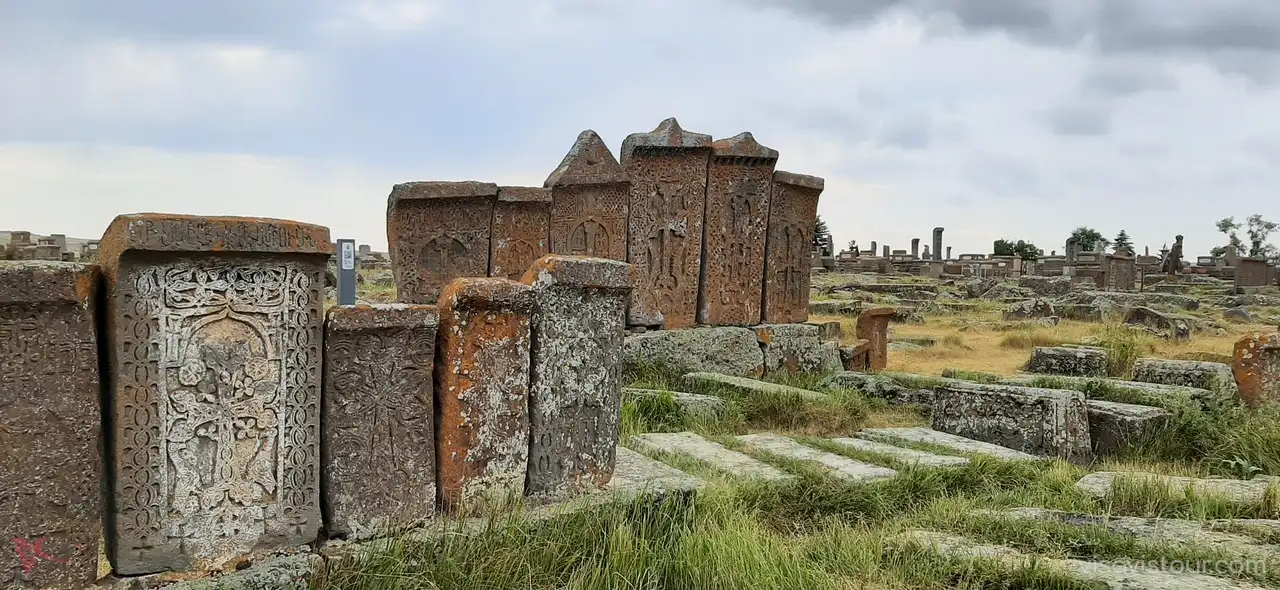
Visit to Hayravank Monastery( 9-th – 12-th centuries). Travel to Noratus, famous for its cemetery, where a large number of khachkars have been preserved. Most of them date back to the 13th-17th centuries.
A trip through the Selim Pass to the resort town of Jermuk.
On a way visit Selim Pass Karavansaray, which was used for having a rest by Silk road caravans.It was built in 1332, by prince Orbelian. Here, merchants and travelers found shelter from the harsh mountain climate and could rest, continuing their journey with renewed strength. The caravanserai is one of the few remaining in the Caucasus and is a striking example of ancient infrastructure that supported trade and cultural ties.
Jermuk famous for its healing hot mineral springs. The beauty of Jermuk is known far beyond the borders of Armenia. No wonder it is called the green pearl of Armenia. Piercingly blue – light blue sky, bizarre outlines of mountain ranges, the dull noise of a mountain river in the depths of a canyon framed by rock fragments, cool spicy air, the murmur of mountain streams, a cascade of artificial ponds and a foamy waterfall, white buildings of sanatoriums, buried in the greenery of spreading poplars and mighty blue spruces. Picturesque canyon leading to the waterfall. Here you can take many beautiful pictures as a keepsake of this paradise.
Visit to a winery with a tasting of Armenian wine. Return to Yerevan.
Overnight in Yerevan.
Yerevan - Haghpat Monastery, Zarni Parni Cave and Fortress Complex, Akhtala Fortress - Aramyants Castle - Sanahin Monastery - Yerevan
Breakfast at the hotel. Trip to the north of Armenia to the Haghpat and Sanahin Monasteries (Lori Region), listed as a UNESCO World Heritage Site (1996). Visit to the functioning Haghpat Monastery (10th century), located on a small plateau surrounded by gorges. In the 10th-13th centuries, it was one of the spiritual and cultural centers of Armenia. Here they studied the humanities, theology, painted and copied books. For some time, the great Armenian poet-ashugh Sayat-Nova lived in the Haghpat Monastery, about whose life Sergei Parajanov made his famous film “The Color of Pomegranates”. Part of the filming took place in this Monastery.
Then visit the cave-fortress complex of Zarni Parni.
Drive to Akhtala Fortress. Akhtala Monastery (13th century) is unique for its perfectly preserved frescoes on the walls.
Visit to Aramyants Castle, after to Sanahin Monastery (10th century). In the 12th century, there was a medical school in Sanahin where human anatomy and physiology were studied.
Return to Yerevan.
Overnight in Yerevan
Yerevan – Amberd Fortress – Mount Aragats (Kari Lake) – Dried Fruits & Eco Products Factory – Saghmosavank Monastery – Armenian Alphabet Monument – Yerevan
Breakfast at the hotel.
Trip to Amberd Fortress — an outstanding example of medieval architecture (11th–13th centuries). Its majestic structure rises above the gorge. The fortress is surrounded by massive defensive walls with towers. Everything here served a defensive purpose. The architecture is simple and austere. Amberd had two reservoirs and its own water supply system. This castle was the ancestral estate of the Pahlavuni princes. Within the fortress stands the Church of Amberd, built in 1026.
Continue to the high-mountain Kari Lake, located in the crater between the four sharp peaks of Mount Aragats, at an altitude of 3,207 meters above sea level. Mount Aragats is the highest peak (4,090 m) of the Armenian Highland within the borders of modern Armenia. The beautiful landscape of foothills and alpine zones attracts hiking and mountain climbing enthusiasts. In summer, the slopes are covered in a lush, flowering carpet. Before you open up flower valleys so vibrant that their colors seem almost surreal. Here you’ll find lavender, balsam, sage, alpine chamomile, bellflowers, wild dill, and other alpine herbs. The Aragats massif is an inexhaustible source of water for Armenia.
Next, visit a dried fruits and eco-products factory. The factory produces dried fruits without sugar or additives, as well as dried vegetables and chips.
Trip to Saghmosavank Monastery, located on the edge of a rocky cliff overlooking the picturesque Kasagh River gorge. Saghmosavank dates back to 1215 when, by the order of Prince Vache Vachutyan, the Church of Surb Sion was built here.
Visit the Armenian Alphabet Monument, located on a small plain where all the letters of the Armenian alphabet are carved from tuff stone, each the height of an average person. Each letter features artistic design, and they are scattered naturally among volcanic stones, as if emerging from the distant past. Tourists love to take selfies next to the first letter of their name.
Return to Yerevan.
Overnight in Yerevan.
Yerevan – Garni Temple (lavash baking) – Geghard Monastery – Yerevan
Breakfast at the hotel.
Excursion to the pagan Temple of the Sun (1st century AD) in the village of Garni.
Built in classical Greco-Roman style with a full colonnade and perched on a cliff overlooking a deep gorge, the temple offers a striking and surreal view. Garni once served as the summer residence of the royal Arsacid dynasty. The temple was destroyed by a powerful earthquake in 1679 and later restored between 1969 and 1974.
Parts of the surrounding fortress wall have survived, along with ruins of the royal palace and ancient bathhouse. Of particular interest is the bathhouse’s mosaic floor, bearing the inscription: “We worked but received nothing.” Inscriptions in Greek confirm that the temple was built in 77 AD by King Trdat I of the Arsacid Dynasty.
Continue to Geghard Monastery, a rare and awe-inspiring 12th–13th century complex partially carved into the mountainside. The name “Geghard” means “Holy Lance”, referring to the spear that pierced Christ’s side during the crucifixion, which was long housed here (now in the museum of Etchmiadzin Cathedral). Nestled in a scenic gorge of the Azat River, Geghard is a masterpiece of Armenian medieval architecture. The complex includes a main church, two cave churches, and a royal mausoleum. In one of the cave chapels, a cold spring flows directly from the rock, believed to have healing properties, to restore youth and beauty. Geghard Monastery was inscribed as a UNESCO World Heritage Site in 2000.
Experience a demonstration of traditional Armenian lavash bread baking in a rural home. Watch this UNESCO-recognized practice as the dough is skillfully prepared and baked inside a clay oven known as a tonir.
Return to Yerevan.
Overnight in Yerevan
Yerevan - "Old Areni" winery (tour and tasting) – Tatev Monastery (return by the Wings of Tatev Cable Car) - Khndzoresk Caves - swinging bridge - Yerevan
Breakfast at the hotel.
Drive to Areni village – the cradle of winemaking. During recent archaeological excavations in the Areni region (Vayots Dzor province) in modern Armenia, a 6,100-year-old winery and 5 wine cellars were found. Archaeologists found containers for pressing grapes, fermenting and storing wine, drinking cups, grape vines and seeds. This winery and cellar are still recognized as the oldest in the world. Archaeologists suggest that our early ancestors used wine in ceremonies to honor the dead, as well as as a gift placed inside tombs. This is evidenced by the wine jugs and cups found in the burial sites. According to Armenian and American scientists, these are the only complete and most ancient excavations of wine production in the world (over 6,000 years). These findings indicate a high level of winemaking in those days on the territory of Armenia.
Visit to the Areni winery with tasting of different types of wine.
On the way to Tatev Monastery, visit one of the most beautiful waterfalls in Armenia – Shaki. Continuation of the journey to the Wings of Tatev cable car, built in 2010, which is the longest cable car in the world. It is listed in the Guinness Book of Records.
Travel by car to Tatev Monastery (return by cable car). Tatev Monastery is one of the most unique and beautiful monasteries in Armenia. It is located at the edge of a deep gorge and is surrounded by powerful fortifications. The Tatev complex is in harmony with the surrounding mountain landscape. In the past, Tatev was not only a religious but also a political center of the Syunik principality. At one time, there was a university here, which had three departments: music (spiritual chants), painting and science. The latter studied the Old and New Testaments, and also dealt with the translation of manuscripts of spiritual and secular content from Greek and other languages. The complex includes the central temple – the temple of St. Poghos-Petros (11th-10th centuries), the church of St. Grigor (13th century), the abbot’s chambers (17th century), a refectory with a kitchen and storerooms, and monastic services. In the 10th century, the monastery had about 1,000 inhabitants, including artisans, in whose workshops works of applied art were created, an example of which are the finely carved khachkars and doors of the temple.
Visit to the ancient caves of Khndzoresk, located on the slopes of a mountain valley. The houses in Khndzoresk were built one on top of the other or built into the caves. Due to its impregnable position, it was the center of the struggle for independence. The leader of the resistance, who fought in the 18th century against Persia and the Ottoman Empire, Mkhitar Sparapet, is buried here.
In 1913, Old Khndzoresk was one of the largest villages, with 7 schools and 1,800 houses, as well as 4 churches: St. Hripsime, St. Tadevos, Anapati and Old.
During the Soviet era, the residents left their cells and moved to New Khndzoresk. Now Old Khndzoresk has become one of the most important ancient monuments in Armenia.
A 100-meter suspension bridge has recently been built across the gorge in Khndzoresk, offering a magnificent view of the gorge and the surrounding area. Return to Yerevan.
Overnight in Yerevan
Transfer to the airport and departure
Breakfast at the hotel. Check-out before 12:00. Transfer to the airport 2.5 hours before departure.
Tour Package Prices Per Person in Double Room
| Hotel Name | DBL | SNGL | third adult | 6-12 Child |
|---|---|---|---|---|
| Elysium Gallery 3*, Mandarin or similar | ||||
| Ani Central Inn 4* or similar | ||||
| Ani Plaza 4* or similar |
Tour Package Price Includes:
- Accommodation at the hotel (7 nights)
- Breakfasts
- Transfers and transportation services according to the program
- Services of a professional guide
- All entrance tickets according to the program
- Ticket to the Wings of Tatev cable car (return trip)
- All master classes according to the program
- All tastings according to the program